
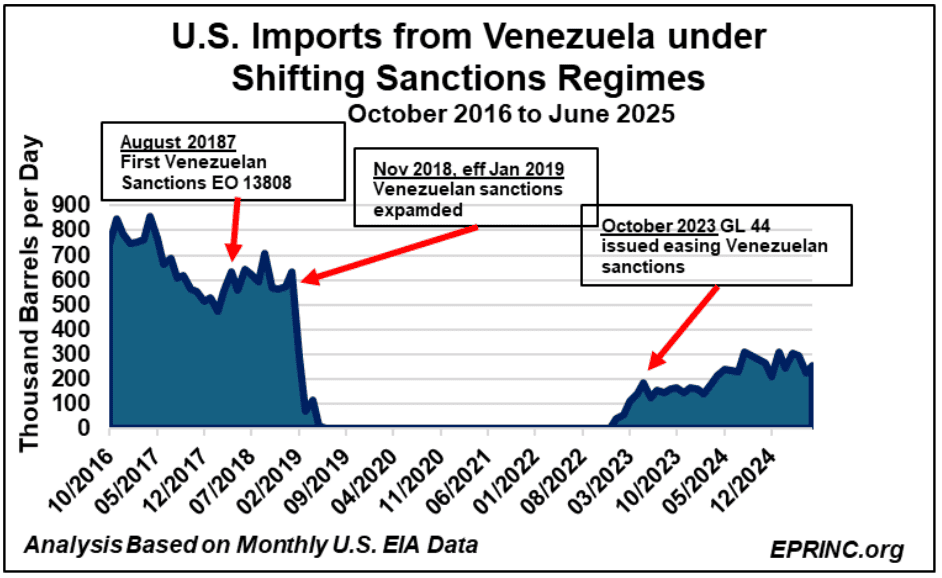
The U.S. refining fleet, at 18.4 million barrels per day (mbd), relies on large volumes of heavy and medium crudes that are primarily sourced from imports. The bulk of these come from neighboring Canada and Mexico, but additional sources are still required. The chart tracks U.S. crude oil and product imports from Venezuela, which supplied 630 thousand barrels per day (tbd) through January 2019.
Rising human rights abuses and political oppression have deepened poverty and driven 7.7 million refugees from Venezuela. In response, the Trump administration expanded sanctions through Executive Order 13850 (issued November 1, 2018, effective January 2019), prohibiting transactions with PdVSA, Venezuela’s state oil and gas company, by U.S. entities and driving U.S.-bound Venezuelan exports to zero.
On October 18, 2023, the Biden administration issued General License 44 (GL 44), moderating energy sanctions under the terms of the Barbados Accords, which called for an easing of President Nicolás Maduro’s political oppression, with a reassessment due April 18, 2024. In response, the Venezuelan government released 20 political prisoners and 10 Americans and made other accommodations, and the U.S. abided by its side of the agreement. However, steps toward free and fair elections were not completed by the April 18, 2024 deadline, with over eight hundred political prisoners still held. The July 2024 elections clearly favored Maduro’s opponent, Edmundo Gonzalez Urrutia, but Maduro proclaimed himself the winner and began a third term on January 10, 2025.
On January 3, 2026, the U.S. took military action extraditing Maduro to New York City to be charged and stand trial, raising speculation over the future of Venezuela’s oil industry. Venezuela once produced approximately 3.5 mbd, but under the administrations of Hugo Chavez (1999–2013) and his successor Maduro, production languished due to nationalization, chronic underinvestment, and poor management; current output is estimated at 900 tbd.
There is no indication whether U.S. sanctions against Venezuela’s oil industry will be lifted entirely. Enforcement, however, could become lax, rendering them moot. EPRINC trustee and oil industry professional Ivan Sandrea has posted his views, “Ten Principles for Rebuilding Venezuela’s Petroleum and Mineral Industries,” on LinkedIn.
From the EPRINC Chart of the Week archive.