
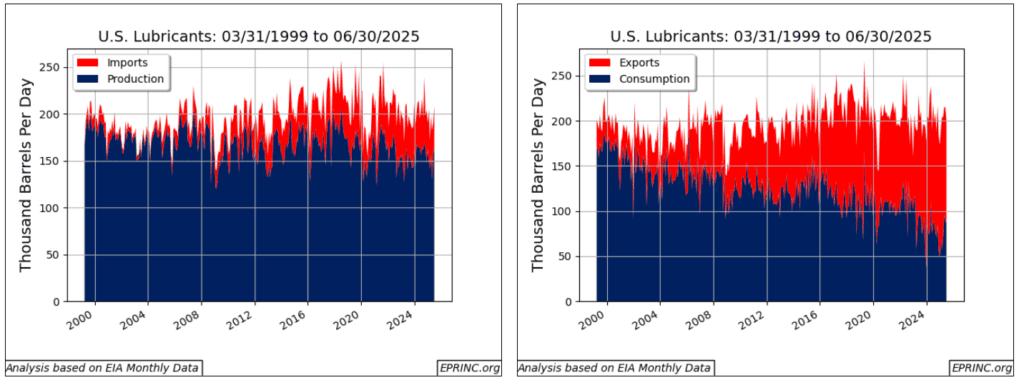
Lubricants and petroleum products both derive from the distillation of crude oil, yet they serve opposite functions. Petroleum products are used to produce heat or steam to propel vehicles or spin turbines, while lubricants absorb heat, reduce friction and wear, facilitate braking, and minimize corrosion. One is volatile; the other is inert.
At roughly 200 thousand barrels per day (TB/d), the U.S. lubricant market is only a small share of the overall hydrocarbon market of some 18 million barrels per day (MB/d) that spans the full array of petroleum products.
The chart tracks U.S. lubricant supply and demand, and it shows that the same North American Petroleum Renaissance that turned the United States from a net importer into a net exporter of petroleum products has reshaped lubricant trade flows as well. U.S. lubricant exports have risen from 30 TB/d in 2000 to nearly 130 TB/d today.
From the EPRINC Chart of the Week archive.