
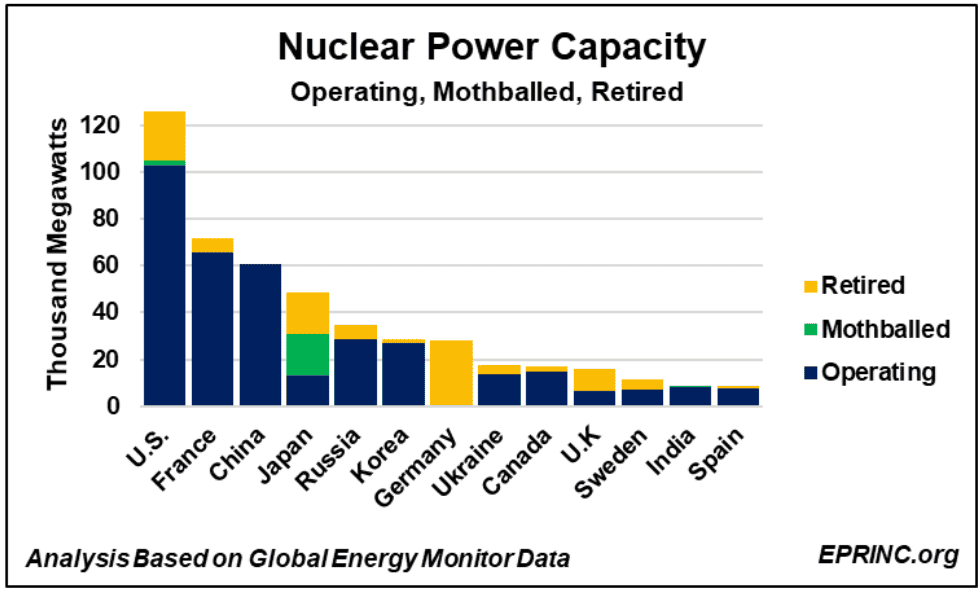
Nuclear power generation carries several compelling qualities: a small footprint, high-capacity utilization, and low operating costs that, taken together, consistently deliver among the lowest electricity prices. As forecasts point to rapidly rising global electricity demand — driven by the expansion of data centers and manufacturing — attention has turned to nuclear power’s potential to help fill the expected supply gap. In the United States and Japan, mothballed and retired capacity is viewed as a partial means of bridging these electricity supply needs.
The charts rank countries three ways. The first ranks countries by their combined existing, mothballed, and retired nuclear power capacity. The second ranks countries by capacity under active construction and in pre-construction, reflecting the recognized need for more electricity. The third addresses cancellations.
Lengthy project timelines, high capital costs, and uncertainty in policy support — the last of which is critically required for project completion — impede commissioning and have led to numerous cancellations. These obstacles temper the near-term contribution new nuclear construction can make to closing the projected supply gap.


From the EPRINC Chart of the Week archive.