
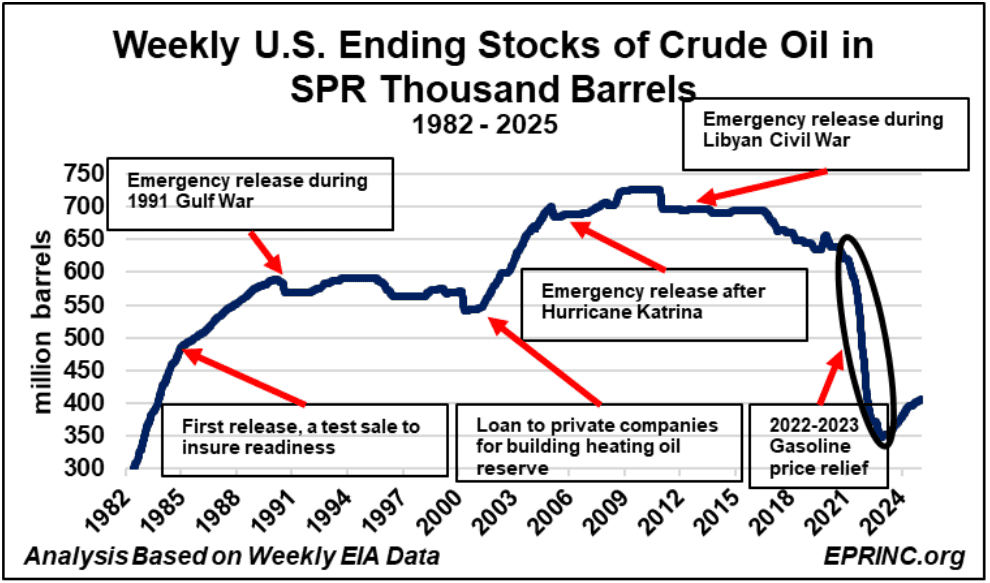
The Strategic Petroleum Reserve (SPR) was established in the 1970s by an act of Congress in response to the oil supply shortages caused by the politically motivated October 1973 Arab oil embargo. It is designed to hold approximately 750 million barrels in salt caverns along the U.S. Gulf Coast, close to key refining centers and pipelines capable of transporting crude oil inland to refineries near other consuming regions.
The scenarios anticipated for an SPR release were oil supply disruptions brought on by events such as military conflicts, geopolitically motivated embargoes, major oil supply infrastructure accidents, and extreme weather.
Beginning in November 2021, the Biden Administration authorized releases of crude oil from the SPR. These releases continued through 2022 and concluded in March 2023, with the stated motivation of providing price relief for consumers. The total release of 220 million barrels was the largest in the SPR’s history, drawing storage down to just over half of the reserve’s capacity. Since then, the SPR has been only partially replenished, with 50 million barrels returned.
Marking the 50 + 2nd anniversary of the embargo that prompted its creation, EPRINC examines the reserve’s original rationale, its subsequent usage, and the management it requires in the current moment and in anticipated future emergency scenarios. A fuller discussion appears in “The Strategic Petroleum Reserve: 50 + 2 Years Since the Key Inciting Incident,” by Max Pyziur, Matthew Sawoski, and Lucian Pugliaresi.

From the EPRINC Chart of the Week archive.