
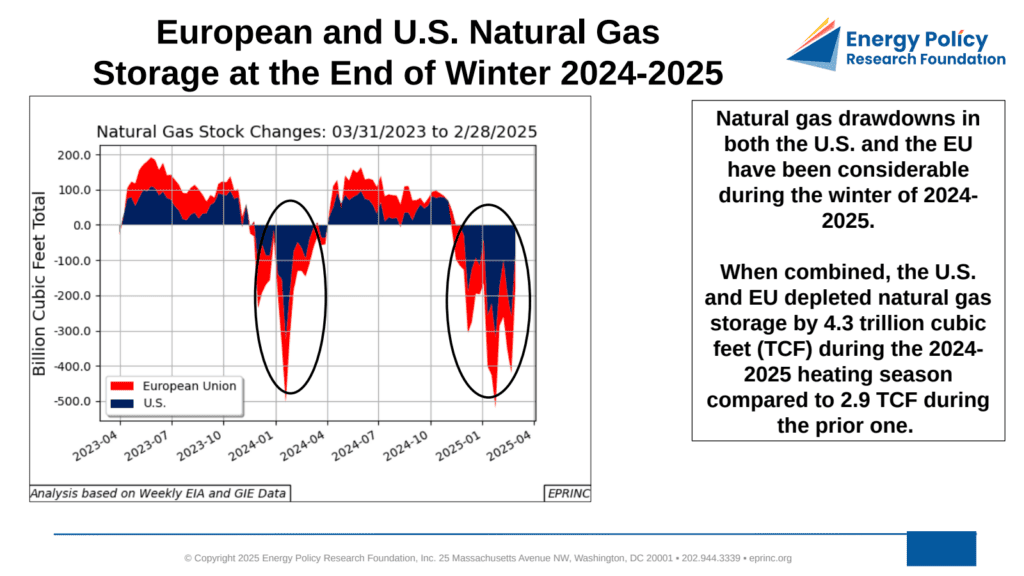
The winter of 2024-2025 in the Northern Latitudes was longer and more severe than recent years, especially in February. Measured by heating degree days, the EU experienced a February that was 4.4% more intense than February 2024, though several cities saw far larger swings: cumulative temperatures ran 14% lower in Munich, 20.5% lower in Paris, and 25.5% lower in Vienna.
In the United States, February 2025 heating degree days exceeded 2024’s by 25.5%, with certain Midwestern cities well beyond that figure. Chicago’s February degree days ran 43.5% above the prior year, and St. Louis’ were 58.9% greater.
The colder season produced considerable storage drawdowns on both sides of the Atlantic. Combined, the U.S. and EU depleted natural gas storage by 4.3 trillion cubic feet (TCF) during the 2024-2025 heating season, compared with 2.9 TCF the prior season.
The result is that natural gas inventories now sit at low levels. As EPRINC Research Director Max Pyziur noted, EU inventories in particular have fallen below 40% of total capacity, meaning replenishment during 2025 will need to be more aggressive.


From the EPRINC Chart of the Week archive.