
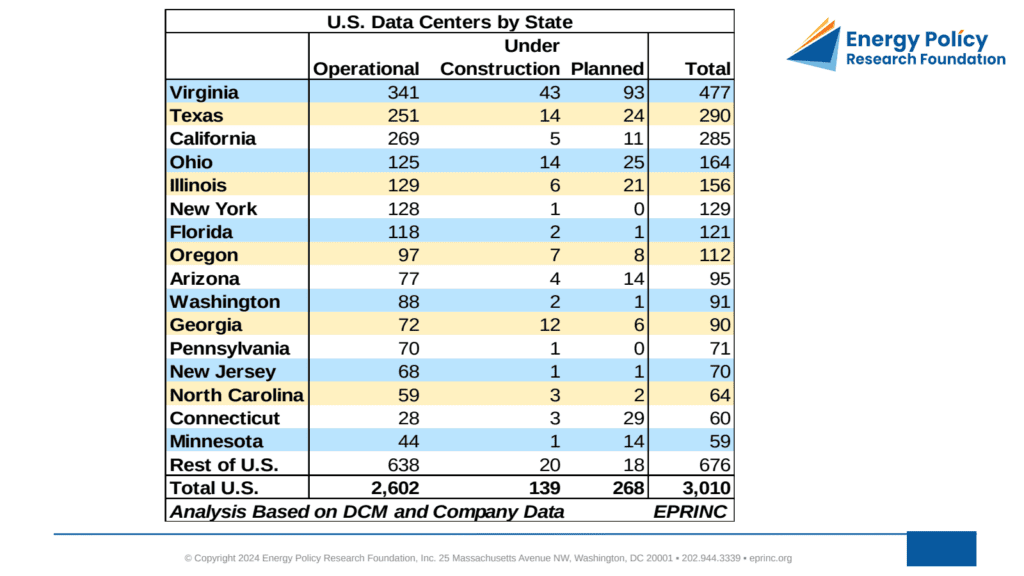
To better assess data center power demand, EPRINC has begun collecting data at the facility level. Two summary tables present the current picture: in 2024, using the best available resources, there are 2,602 operating data centers, with an additional 139 under construction and 268 planned. Total projected load growth is 19,270 MW, of which 7,543 MW is under construction and another 11,727 MW is planned. These summaries are provisional and will likely be restated upward as more and better information becomes available.
Data centers are not distributed evenly across the country. They cluster in states with affordable commercial real estate, robust network connectivity, infrequent natural disasters, and lower-cost electricity. Virginia, Texas, and California dominate the installed base with 341, 251, and 269 centers, respectively. Virginia is set to extend its lead by adding another 136 centers — 43 under construction and 93 planned — with total projected power needs of 6,344 MW.
Virginia’s expansion is reshaping its power demand. From 2009 to 2019, the state’s commercial power demand grew at an annual rate of 1.4 percent; from 2019 to 2023, it accelerated to 5.8 percent, driven primarily by data center growth — a pace that would double commercial demand within twelve years. Over the same period, Virginia’s residential and industrial electricity demand declined by 1.6 percent and 1 percent, respectively.
Growth in data centers has been driven by entertainment streaming, telecom, security devices, and industrial data-gathering, and is now expected to accelerate further with generative artificial intelligence. An AI data request consumes roughly ten times the electricity of a typical Google search, but the rate of future AI adoption is uncertain, complicating power generation planning. Where aggregate U.S. power demand has been flat for twenty years, utilities and regulators now appear to face the need to restate load forecasts upward and to restart mothballed or add new dispatchable generating capacity.
These concerns crested on November 1, 2024, when FERC held its Commissioner-Led Technical Conference Regarding Large Loads Co-Located at Generating Facilities and, the same day, issued a major decision denying Talen Energy’s agreement with Amazon (AWS) to divert up to 480 MW directly to a planned AWS data center. In both the conference and the decision, FERC’s stated concern was to prioritize grid reliability.

From the EPRINC Chart of the Week archive.