
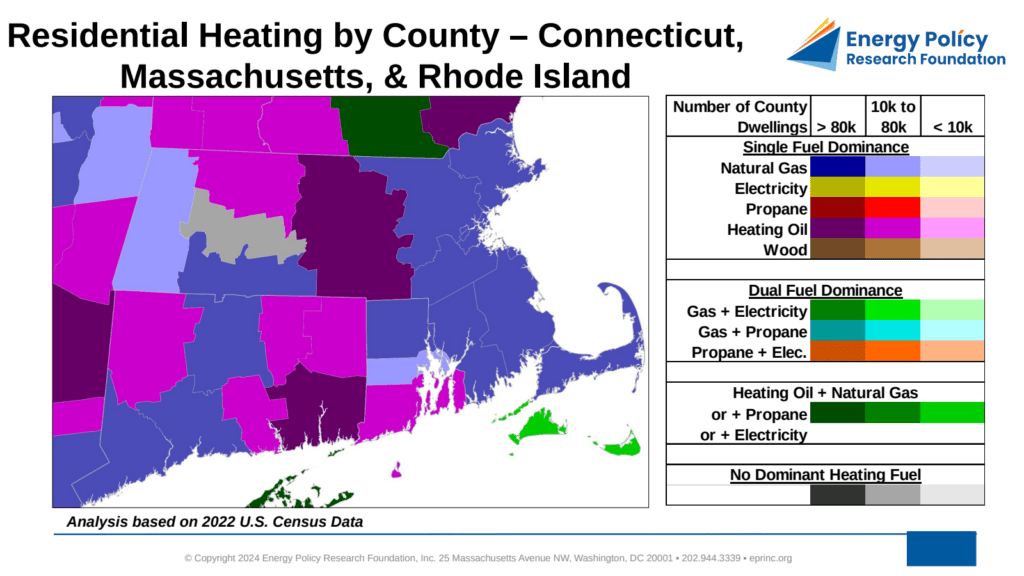
The chart series examines how the New England states of Massachusetts, Connecticut, and Rhode Island — a combined population of 11.7 million — depend on natural gas for both home heating and electricity generation. According to the 2022 U.S. Census Survey of Home Heating, 2.2 million (47%) of the three states’ 4.7 million households heated their premises with natural gas, 1.3 million (27%) used heating oil, and 833 thousand (18%) used electricity. County-level Census data (Figure 1) show natural gas dominant across much of the region, with heating oil prevalent elsewhere.
Over the last two winters, residential and other natural gas demand peaked at 3 BCF/d (Figure 2). At the same time, natural gas has become the leading fuel for U.S. electricity, rising from 16% of generation in 2000 to 43% in 2023. During January and February 2024, gas-fired generation delivered on average 56% of the three states’ combined daily electricity requirements (Figure 3).
“With electricity production and other uses vying for natural gas, issues of interdependent reliability have developed. Unlike coal and petroleum liquids, natural gas is generally not stored on-site at points of consumption,” noted Max Pyziur, EPRINC’s Director of Research Programs. “During high demand periods or situations of adverse weather, contention for natural gas can jeopardize reliability.”
New England is served by the Williams, Kinder-Morgan, and TransCanada pipeline systems and one LNG receiving terminal. On July 30, 2024, the U.S. Court of Appeals for the D.C. Circuit rejected FERC’s approval of Williams’ Regional Energy Access System, which was already in operation, effectively ordering a shutdown. Williams is challenging the decision, warning that a shutdown could lead to “catastrophic” shortages and high prices.
- February 2021’s Winter Storm Uri, when frozen gas pipeline and transmission equipment impeded deliveries in Texas, producing extended blackouts and hundreds of fatalities.
- January 2019, when Newport, Rhode Island’s natural gas distribution system interrupted service to 7,400 homes for 7 days because of low system pressure.
- Constellation Energy’s August 2020 announcement citing the need to shut down Boston Harbor’s Everett LNG receiving terminal, which would have forced the area to find alternative gas supplies; Massachusetts regulators intervened and are seeking to keep the terminal open through 2030.
The Congressional Research Service report “Natural Gas Reliability: Issues for Congress,” published July 15, 2024, addresses these and related issues relevant to Congressional deliberations.


From the EPRINC Chart of the Week archive.