
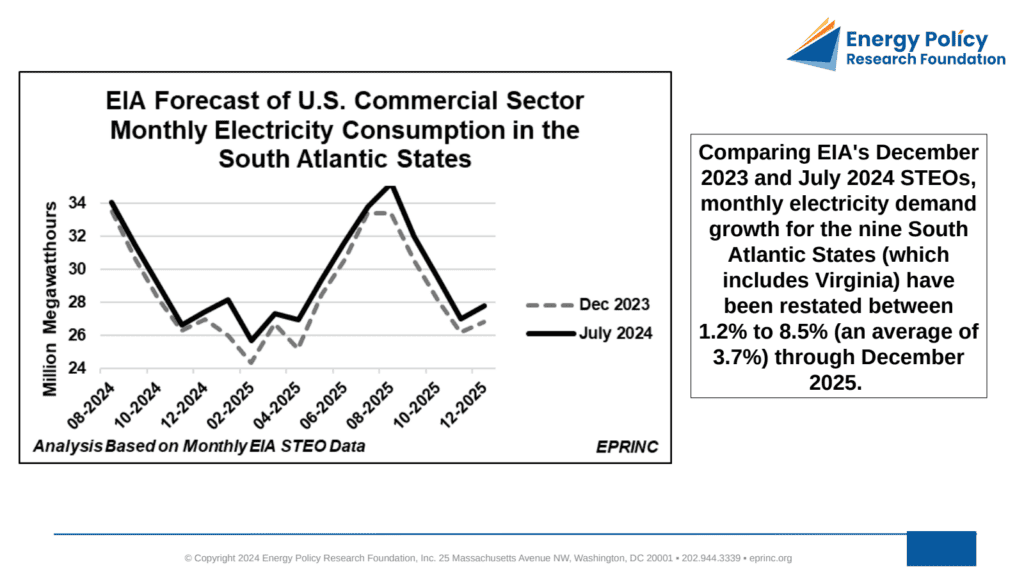
The chart draws on the U.S. Energy Information Administration’s (EIA) Short-Term Energy Outlook (STEO), a monthly publication that assesses expected supply and demand balances for key U.S. energy sources over the subsequent 18 to 24 months at both national and regional levels. Because these outlooks are subject to frequent revision, comparing successive editions reveals how expectations for electricity demand are shifting.
Comparing the EIA’s December 2023 and July 2024 STEOs, projected monthly electricity demand growth for the nine South Atlantic states—a region that includes Virginia—has been restated higher by between 1.2% and 8.5%, an average of 3.7%, through December 2025. Viewed on a trailing twelve-month basis, the gap between the two assessments is more pronounced.
Recent guidance from major investor-owned utilities has similarly indicated that projected demand growth has needed to be revised upward relative to prior assessments. While rising electrification in residential heating and increased manufacturing are contributing factors, the reason most frequently cited is the expected expansion of data centers.
Concentrations of data centers are found in Texas, Northern Illinois, California, and Washington State (see this related analysis). The largest share, and the expected continued expansion, is in Northern Virginia, which offers ample space, affordable electricity, proximity to key high-capacity transmission lines, and infrequent natural disasters.
Generation capacity is in place through 2025 to accommodate this demand growth. However, if elevated demand growth continues, concerns are increasingly being raised about the long-term availability of adequate capacity.


From the EPRINC Chart of the Week archive.