
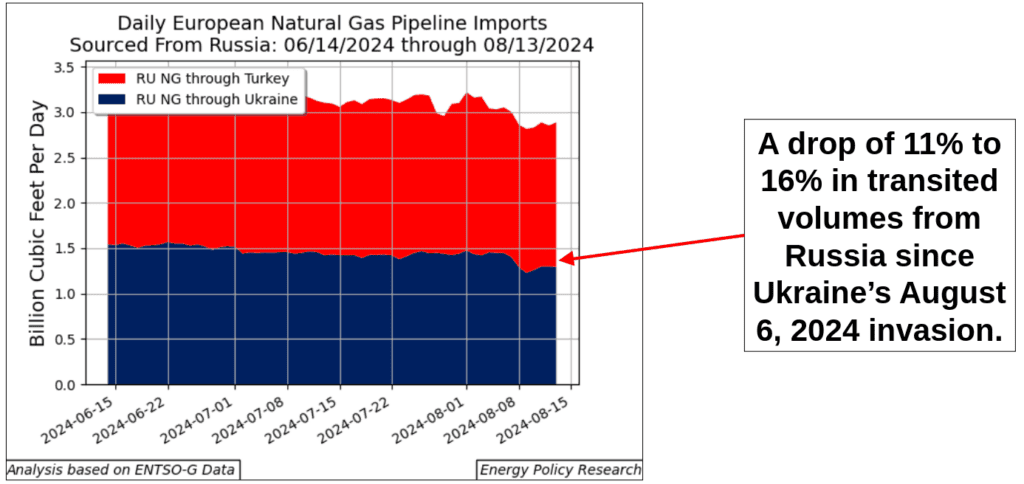
The chart tracks daily volumes of Russian natural gas transited through Ukraine around the time of Ukraine’s August 6, 2024 incursion into Russia’s Kursk Oblast. Just prior to the invasion, 1.45 billion cubic feet per day (BCF/d) was moving through the system. Volumes then fell 16% to 1.22 BCF/d on August 9, and stood at 1.29 BCF/d—off 11%—on August 13.
Ukraine has the pipeline capacity to transit up to 15 BCF/d of Russian gas to several receiving points on its western border for onward delivery into Central and Western Europe, the largest crossing being at the Ukraine/Slovakia border, with Austria among the largest recipients. Two primary compressor stations inside Russia had fed the system: one near Sudzha on Ukraine’s northeastern border and one at Sokhranivka on the eastern side. Since May 2022, Ukraine’s pipeline operator has suspended transit from Sokhranivka, citing wartime dangers, leaving Sudzha as the sole entry point.
On August 6, 2024, two to three brigades of the Ukrainian Armed Forces invaded and occupied a substantial portion of Kursk Oblast near the town of Sudzha, seizing Gazprom’s Sudzha compressor station, located just across the border from Ukraine.
The transit arrangement is governed by a December 2019 agreement between Russia and Ukraine running through the end of 2024, under which Russia committed to a take-or-pay minimum of 4 BCF/d from 2021 to 2024. Since escalating its war in February 2022, Russia has shipped a steady 1.5 BCF/d through Ukraine. Russia receives 7–8 billion euros for gas exported to Europe, while Ukraine currently collects roughly $800 million in transit fees—below the $1.5 billion minimum stipulated in the 2019 contract.
Russia’s dependence on hydrocarbon exports to fund its war effort is well established, and control of the Sudzha crossing places a meaningful share of that revenue stream, along with Europe’s remaining pipeline supply from Russia, in a contested zone.
From the EPRINC Chart of the Week archive.