
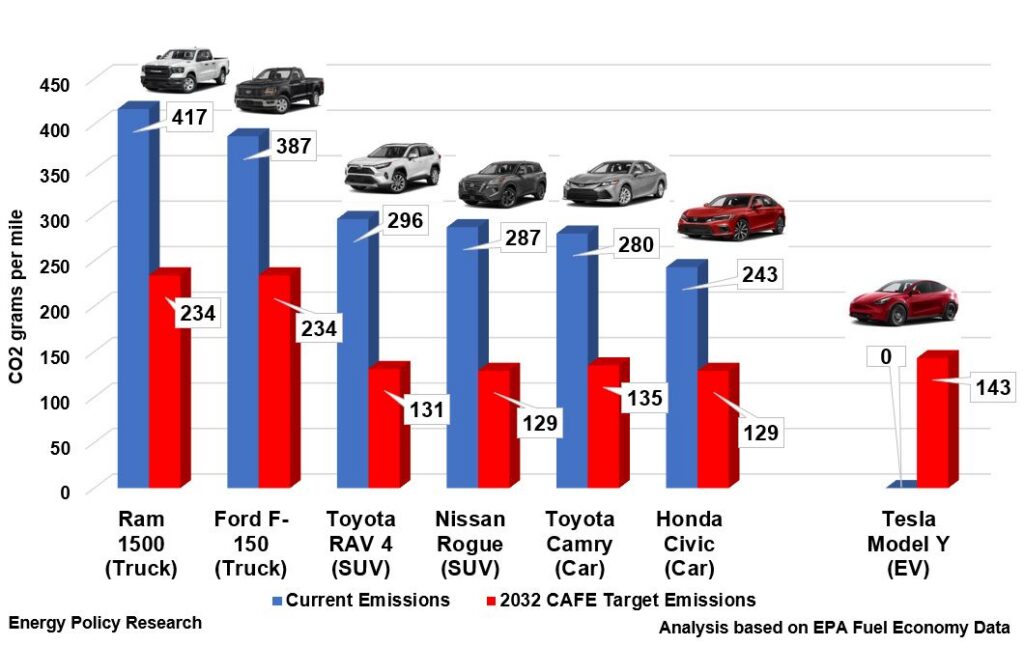
In March 2024, the EPA raised existing Corporate Average Fuel Economy Standards (CAFE) from already high levels, requiring light-duty vehicle emissions to reach half of current levels by 2032. The chart compares the emissions of currently popular vehicles against the compliance levels the new standards will require.
Legacy petroleum-powered vehicles, even with aggressive technological advances alone, are not expected to achieve these standards. Manufacturers are instead anticipated to attain compliance through increased sales of fully electric vehicles (EVs). Because the CAFE credit provided by an EV is comparable to the debit incurred by a gasoline vehicle, meeting the 2032 target would imply that automakers must sell roughly one EV for every gasoline car.
Considerable uncertainty surrounds whether and how automakers will be able to comply, given the size and availability of EV supply chains. If manufacturers cannot meet the standards through sales, they will incur fines, the cost of which is likely to be passed through to consumers.
This chart is informed by a forthcoming EPRINC report, Electric Vehicles vs Internal Combustion Engines: An Energy Economic Analysis.
From the EPRINC Chart of the Week archive.