
WASHINGTON/NEW YORK, June 5, 2024 – Originally written in 2009 with one update, EPRINC is today publishing a complete revision of its Gasoline Blending Primer. This expanded version of the Primer concisely explains the evolution of gasoline production and formulation from early efforts to meet rising performance standards to recent blends required by more rigorous pollution regulations and biofuel mandates.
“In the process, finished gasoline that was once a simple combination of a few refined petroleum components usable across a wide geographic space has evolved to many formulations that have become increasingly complex adjusted for the requirements of different regulatory jurisdictions,” commented Max Pyziur, EPRINC’s Research Director. “This is a formidable achievement, but it comes with increasing costs.”
The Primer is updated with discussions of current policy considerations and issues. It is available at this link: https://eprinc.org/wp-content/uploads/2024/06/EPRINC-FYIInBrief-GasolineBlendingAnEPRINCPrimer.pdf
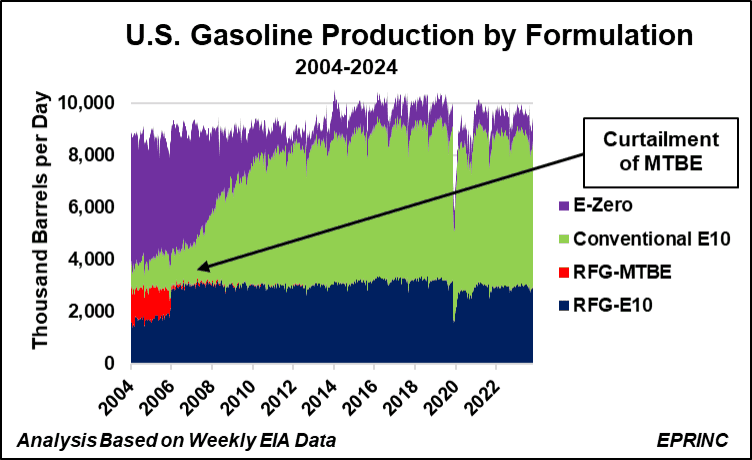
This week’s EPRINC’s Chart of the Week (Figure 1) shows the evolution of gasoline formulations used across the U.S. over the course of the last twenty years. As pollution standards and blending mandates have become more exacting over time, gasoline formulations have been modified to conform to the evolving regulations.
Beginning in the late 1970s, gasoline formulations were increasingly determined by regulatory standards seeking to limit tailpipe pollutants such as carbon monoxide, sulfur dioxide, nitrogen dioxide, and particulate matter. For a motor vehicle’s pollution control equipment to function correctly, especially
Because lead—the dominant octane enhancer but a toxic pollutant as well—could not be used in gasoline with catalytic converters, it was phased out. To maintain octane levels, lead was replaced with other high-octane blending components.
With the 1990 enactment of the Amendments to the Clean Air Act (CAA), the evaporative emissions from gasoline were more stringently controlled in order to reduce the occurrence of ozone, another atmospheric toxin. Beginning in the mid-1990s, California along with certain EPA-designated areas of the U.S. are required to use gasoline that has low evaporative emissions. Dubbed RFG, it now makes up about 25% of all of the different formulations sold in the U.S. Non-RFG gasoline blends are generally referred to as being “conventional.”
To continue lowering tailpipe emissions and to maintain octane levels, oxygenates were introduced. The primary one was MTBE (methyl tertiary butyl ether), and to a lesser degree, ethanol. By the early 2000s, MTBE had become controversial and seen as contaminating water supplies. With the Energy Acts of 2005 and 2007, MTBE was effectively banned and ethanol became the dominant oxygenate and octane enhancer.
Despite environmental requirements, there continue to be non-ethanol gasoline blends that are marketed. Known as E-Zero, it is used in vehicles such as motorboats and snowmobiles whose tanks are prone to collect considerable moisture.
More information is available at: https://eprinc.org/chart-of-the-week/.
From the EPRINC Chart of the Week archive.