
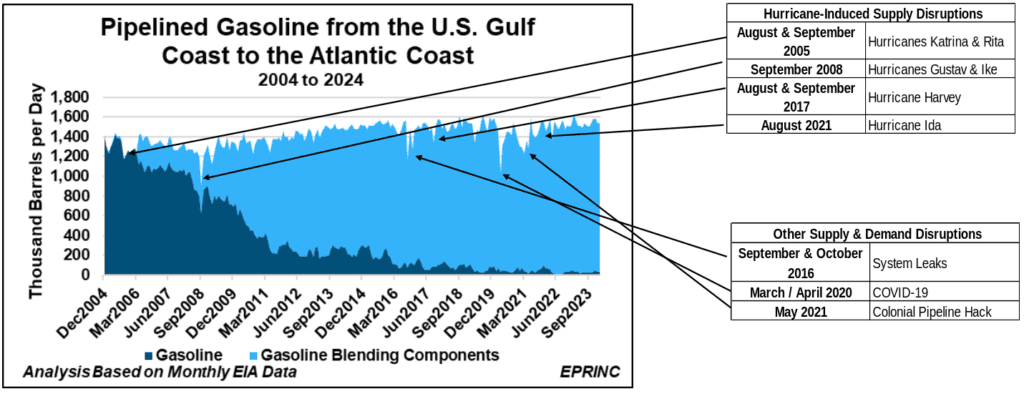
The U.S. Atlantic Coast (USAC) has limited refining capacity and depends on the bulk of its supplies being moved from the U.S. Gulf Coast (USGC), home to over half of the U.S. refining fleet. Gasoline and other petroleum products reach the USAC primarily by product pipeline. The Colonial Pipeline, with 2.5 million barrels per day of capacity — of which 1.4 million is used to move gasoline and related blending components — is the primary USAC-bound product system.
U.S. pipelines generally move refined products efficiently to their destinations, but the system has proven vulnerable. Over the past twenty years, hurricanes have induced major supply disruptions by damaging USGC refining infrastructure, and operational challenges have compounded the risk: the May 2021 cyber-attack that shut down the Colonial system, and major leaks in the lines traversing Alabama in September and October 2016.
On May 21, 2024, the U.S. Department of Energy (DOE) announced sales from the Northeast Gasoline Supply Reserve (NGSR), to take place from May 27 through June 30. The DOE characterized the sales as “strategically timed and structured to maximize its impact on gasoline prices, helping to lower prices at the pump as Americans hit the road this summer.” The NGSR was created following the disruptions caused by Super Storm Sandy in October 2012, which impaired two regional refineries and damaged 40 terminals, some left without power for as long as 30 days. It holds a total of 1 million barrels of gasoline — 700 thousand in New York Harbor, 200 thousand in the Boston area, and 100 thousand in South Portland, Maine.
The timing of the sales coincides with an unusually severe outlook. On May 22, 2024, the National Oceanic and Atmospheric Administration (NOAA) issued its forecast for the 2024 hurricane season, running June 1 through November 30 — the most severe forecast yet made, anticipating 17 to 25 named storms, of which 8 to 13 are expected to become hurricanes with winds exceeding 74 mph. The most intense part of the season generally falls in August and September. By comparison, the 2023 forecast was normal, predicting 12 to 17 named storms with 5 to 9 hurricanes; actual 2023 activity exceeded the forecast with 20 named storms, though the 7 hurricanes that formed fell within the predicted range.
“Gasoline prices are elevated during spring because of a confluence of events, notably the shift from winter to summer grades, with the latter being more costly to produce,” explained Max Pyziur, EPRINC’s Research Director. “Using reserves, notably the NGSR in this case, possibly reduces pump prices a small amount; but it is important to maintain focus on the need to manage risk and be prepared for events similar to the 2012 Super Storm Sandy disruptions.”
From the EPRINC Chart of the Week archive.