
Additional geopolitical stress continues to put upward pressure on transportation fuel prices.
The U.S. 18.4 million barrel per day (mbd) refining fleet relies on large amounts of heavy and medium crudes that are primarily available from imports. The bulk of these come from neighboring Canada and Mexico, but additional sources are still required.
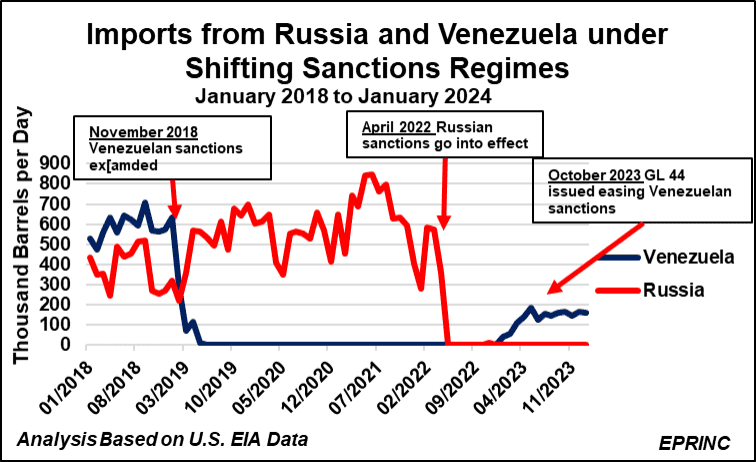
Through January 2019, Russia and Venezuela provided a combined additional amount of 1.2 mbd of imports. (n.b. part of these Russian imports were “unfinished oils,” but these were directly applicable to U.S. refining needs) (Figure 1).
With increasing human rights abuses and other political oppressions that have increased poverty and have driven 7.7 million refugees from Venezuela, the Trump administration expanded sanctions with Executive Order 13850 (issued November 1, 2018, effective January 2019); any sort of transactions with PdVSA (Venezuela’s state oil and gas company) by U.S. entities were prohibited, driving U.S.-bound Venezuelan exports to zero.
With the escalation of Russia’s military aggression against Ukraine in February 2022, the U.S. Congress passed and the President signed in April 2022:
- P.L. 117-109 banning the import of Russian oil and other energy products;
- P.L. 117-110 suspending normal trade relations with Russia and Belarus; and,
- put into place a prohibition on maritime transport services of Russian oil exports above $60/bbl, effective December 2022.
On October 18, 2023, the Biden Administration issued General License 44 (GL 44) moderating energy sanctions against Venezuela with a reassessment due on April 18, 2024. This was done under conditions laid out in an agreement known as the Barbados Accords that the Maduro government’s political oppression would be eased. U.S. receipts of Venezuelan crude oil exports were re-established in January 2023.
So far, the Venezuelan government has released 20 political prisoners and 10 Americans along with making other accommodations in compliance with the Barbados Accords. The U.S. side has also abided
By the terms of the agreement on behalf of Venezuela, actions have not been completed that would lead to free and fair Venezuelan elections ahead of the April 18, 2024 deadline.
Wariness of rising gasoline and diesel prices is a recurring political theme, especially during an election year.
“While there has been limited price impact of the combination of Ukrainian attacks impairing Russian refinery capacity, tankers using longer routes to avoid Red Sea attacks, and declining U.S. product inventories even though refining runs are increasing,” commented Max Pyziur, EPRINC’s Research Director, “they are creating a hard lower bound for crude oil and petroleum product prices ahead of increased summer demand.”
He added, “Without any clear indication ahead of the expiration of the GL 44, there is considerable speculation on what the Biden Administration will do in the face of limited options. Some are expressing the possibility of a renewal of Strategic Petroleum Reserve drawdowns during the summer of 2024 to limit price impacts of constraining policies and events.”
More information is available at: https://eprinc.org/chart-of-the-week/.
From the EPRINC Chart of the Week archive.