
WASHINGTON/NEW YORK, February 14, 2024 – Today, the Energy Policy Research Foundation published the second part of its review of data center energy requirements. As mentioned in Part 1, the number of U.S. data centers is growing to accommodate expanding connectivity needs coming from entertainment (streaming services), telecom (smartphones and tablets), security (doorbell cameras), SCADA (Supervisory Control and Data Acquisition – remote management of industrial processes as well as data-gathering from related devices), and many other needs for data storage and dissemination.
The growth and adoption of artificial intelligence, however, introduces uncertainty over further data center expansion.
“Despite the huge efficiency gains and modest growth in energy demand in the last decade and a half, forecasters anticipate massive processing requirements from the adoption of AI, thereby spiking electricity requirements,” said EPRINC’s energy transition research director Batt Odgerel. “It remains to be seen if this growth will be met through the required resources.”
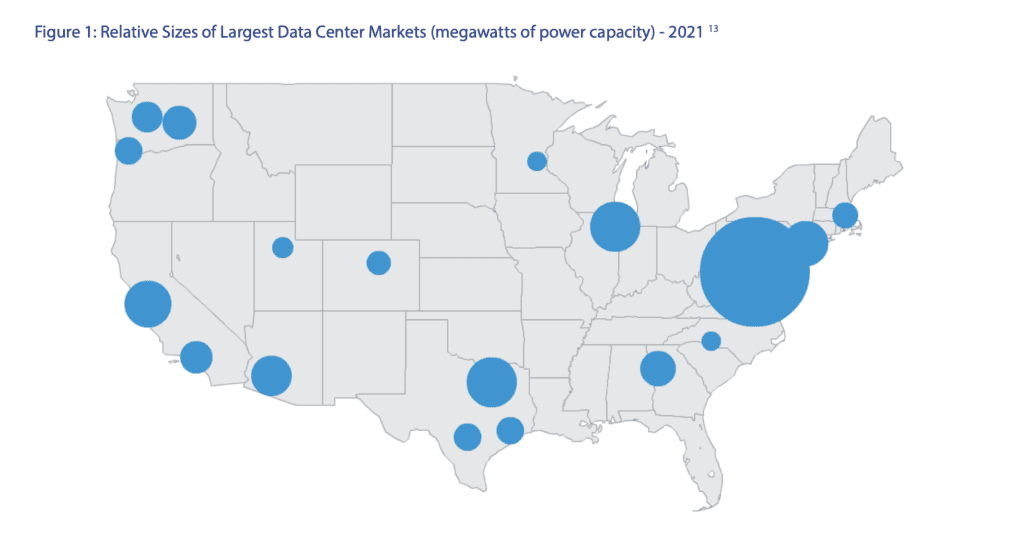
Key states where data centers are located are in California, Washington State, Texas, and Illinois. But the sizeable growth is in Northern Virginia (Figure 1).
As data centers continue to expand, there are several attributes that determine their placement: affordable commercial real estate, robust network connectivity, infrequent natural disaster occurrences, and low-cost electricity (Figure 2). Along with low-cost electricity, Northern Virginia easily meets the other requirements.
Data center power requirements grew by 168% from 2010 to 2023, or just over 4% annually.
However, using Cisco and LBNL (Lawrence Berkeley National Laboratory) data, data center workload (processing, storage, transfer — the power usage effectiveness or PUE, an industry measure of efficiency) grew by 1,430%.
Electricity growth was restrained thanks to efficiency gains coming from faster computer processors, solid-state drives, and fiber-optic network cables (Figure 3).
From the EPRINC Chart of the Week archive.