
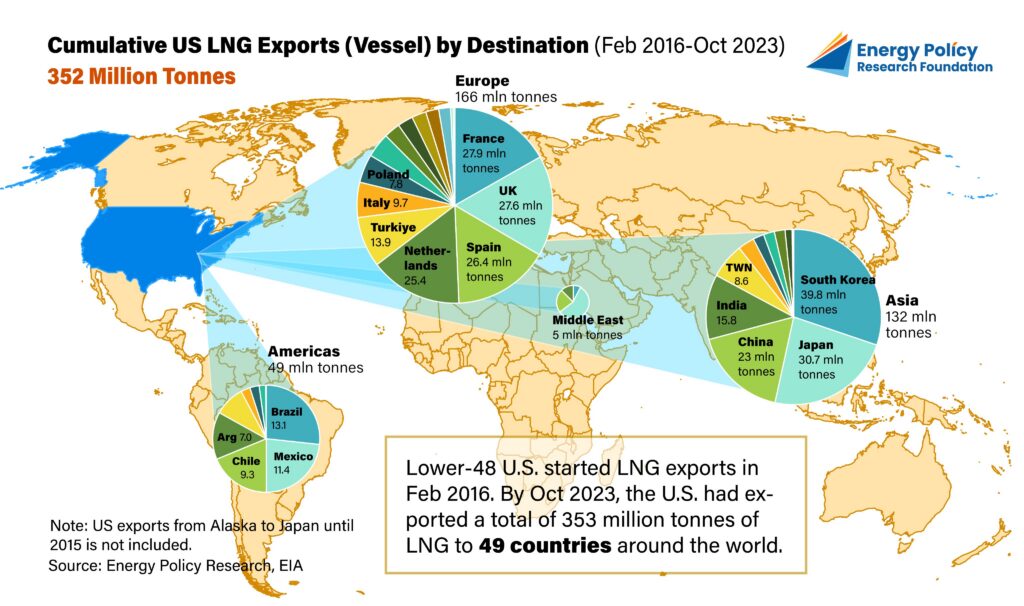
These charts, assembled to accompany two February 2024 Congressional hearings examining the Biden Administration’s pause on new LNG export approvals, review the record of U.S. LNG trade over the past two decades. Over that period the United States has exported 352 million metric tons of LNG to 49 countries, with Europe the largest market, closely followed by Asia.
The European role became especially consequential after Russia began strategically reducing its pipelined natural gas exports in early 2021. In response, Europe increased its imports from other sources, particularly U.S. LNG. Beginning in January 2022, European receipts of U.S. LNG rose from about 2 BCF/d to nearly 8 BCF/d—roughly 50% of Europe’s LNG requirements—and have remained at that level.
“Alliance cohesion in response to Russia’s invasion of Ukraine, and the commercial availability of U.S. LNG exports have been vital,” said Max Pyziur, EPRINC’s Research Director. “Without these fuels Europe’s 2022-2023 winter would have been bleak. Until other resources become available, it’s critically important that these imports continue.”
The trade also bears on the U.S. external balance. At the August 2022 peak, the U.S. trade deficit was $67 billion ($261 billion in exports against $328 billion in imports), with U.S. LNG exports valued at $4.95 billion that month. Absent LNG trade, the August 2022 deficit would have been roughly $72 billion, or 7.5% higher.
Domestically, the growth of natural gas has coincided with declining emissions. U.S. CO2 emissions from hydrocarbon fuel consumption plateaued near 6 billion metric tons from 2004 to 2007 and have since declined, with the EIA projecting 4.75 billion metric tons for 2024—a drop of more than 20% from the peak. Central to this decline has been the displacement of coal-fired generation by natural gas: from 2005 to 2021, coal-fired generation fell to 900 million megawatt hours (an annual rate of nearly 5%), while natural gas-fired generation grew to 1,580 million megawatt hours (an annual rate of 4.7%).

From the EPRINC Chart of the Week archive.