
Despite large efficiency gains, global data center electricity requirements are growing.
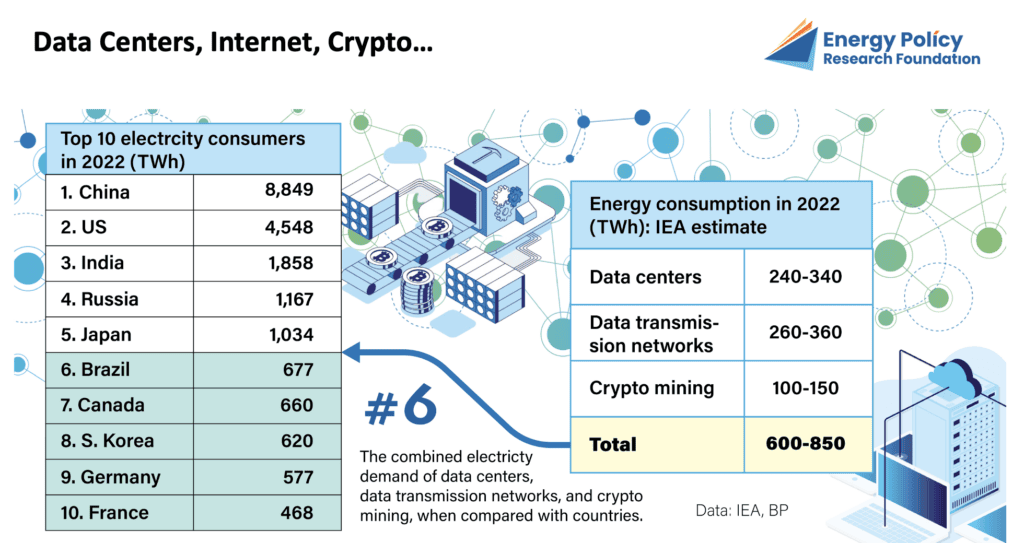
The Energy Policy Research Foundation released a review of data center and network traffic energy requirements. The aggregate global electricity consumption from data centers, data transmission networks, and crypto mining has now reached levels comparable to that of major electricity consuming countries.
With the growing demand for data storage, driven by factors such as remote work, high-speed streaming, and compute-intensive programs (e.g., machine learning), the energy demand of data centers and transmission networks is likely to continue rising. The International Energy Agency (IEA) estimates that in 2022, data centers consumed 240–340 TWh of electricity, data transmission networks 260–360 TWh, and crypto mining 100–150 TWh. The combined range of 600–850 TWh represents around 2–2.9% of the global total electricity consumption, equivalent to the electricity demand of countries such as Brazil, Canada, or South Korea (Figure 1).
Data center power requirements, excluding data transmission networks and crypto mining, have grown from 2010 to 2023 at an annualized rate of just over 4%. The bulk of energy requirements are primarily by servers (Figure 2).
Without efficiency gains, the energy requirements of data centers would have grown exponentially. In 2010, data center energy requirements were 0.43% of global generation; in 2023 they grew to 0.52%. However, during the same period, data center workload (processing, storage, transfer) grew from 58 million units to 821 million, an annual rate of 22.7% (Figure 3).
When viewed in combination, the power usage effectiveness (PUE) (an industry measure of efficiency) showed an improvement 1,430% in 2023 in relation to 2010, while 2023 electricity requirements were 168% of those in 2010. These efficiency gains are attributable to faster computer processors, the increased use of efficient and faster solid-state drives versus legacy mechanical spinning hard drives, and the increased use of high-speed network fiber-optic cables versus legacy copper lines.
However, efficiency improvements do not guarantee reduced/stable demand due to what economists call the “rebound effect.” “Rebound effects arise when there are large gains in efficiency,” said EPRINC President Lucian Pugliaresi. “Rather than promoting conservation and diminished usage of a technology such as the internet, these efficiencies lead to the increased usage of that technology. A good analogy would be that, just as more fuel-efficient motors lead to increased driving rather than less, similarly, with less costly internet service via data centers, people tend to use it more, not less.”
Information on these charts is available at: https://eprinc.org/chart-of-the-week/
From the EPRINC Chart of the Week archive.