
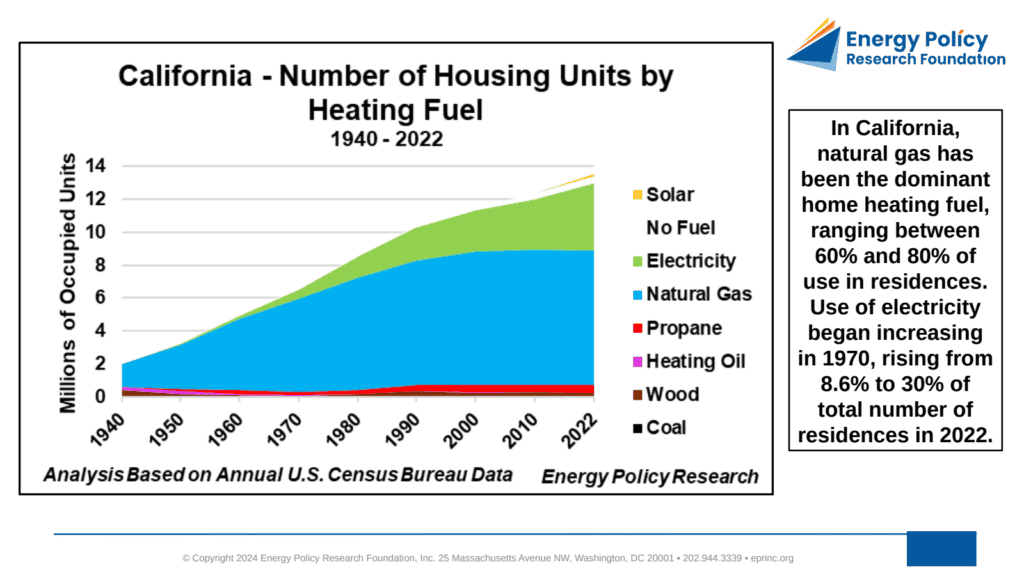
This analysis draws on U.S. Census Bureau data on residential heating fuel to compare three of the largest states by population — California, Texas, and New York State. Located in the West, South, and East, and each with dominant economic and political roles in the country, the three states display distinct developmental profiles when it comes to home heating. Residential growth from 1940 to 2022 was substantial in California and Texas, rising at annualized rates of 2.3% and 2.4%, respectively, while New York State, settled earlier, grew at less than 1% annually.
In California, natural gas has been the dominant home heating fuel throughout the period, ranging between 60% and 80% of residences. Electricity began gaining share after 1970, rising from 8.6% to 30% of total residences by 2022.
Texas has seen the most pronounced shift. In 1940, wood and natural gas dominated residential heating at 47% and 43%, respectively. By 2022, electricity accounted for 61.5% of premises, with natural gas at 34.2%.
New York State retains the most diverse fuel mix. Coal heated 73.2% of residences in 1940, with heating oil at 18.2% making up most of the balance; by 2022 coal had fallen to 0.2%. Natural gas grew to 58.4% of residences by 2022. Heating oil remained important, rising to 65% in 1960 before declining to 16.5% in 2022. Electricity, minimal through 2010, reached 15.3% in 2022, while propane rose from 1.1% in 1970 to 5.2% in 2022.

From the EPRINC Chart of the Week archive.