
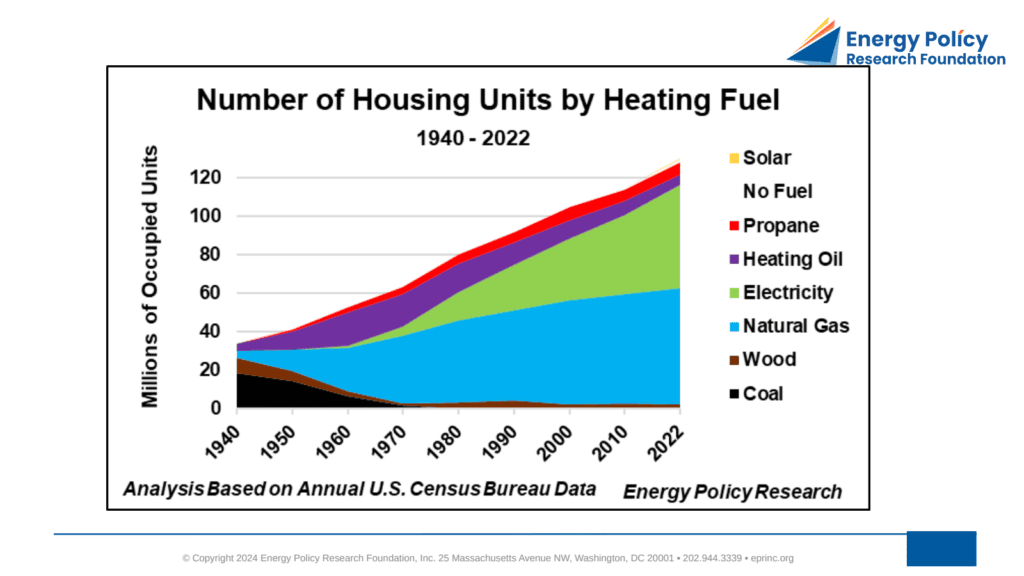
The U.S. Census Bureau has recorded the heating fuel used in occupied housing units since 1940. The resulting data supports government analysis of community air quality, energy forecasts, and the administration of home heating assistance programs for low-income residents. The number of dwellings recorded rose from 33.9 million in 1940 to 129.9 million in 2022, an annual growth rate of 1.65%.
In 1940, coal was the dominant home heating fuel, used in 54.7% of dwellings, with wood a distant second at 23.2%. By 1970, when there were 63 million dwellings, coal and wood had fallen to 2.9% and 1.7%, respectively. Natural gas had become the leading fuel at 55.2%, followed by heating oil at 26%.
By 2022, natural gas remained the largest source but had declined as a share of the total to 46.2%. Electric heating rose sharply over the same period, climbing from 7.7% of dwellings in 1970 to 41.3% in 2022. Solar heating was first reported in 2010, when 41,500 dwellings used it; by 2022 that figure had grown to 423,600, or roughly 0.3% of the total.
According to Max Pyziur, EPRINC’s Director of Research Programs, natural gas has become a major home heating fuel because of its reliability, flexibility, and the minimal residue it generates. He noted that the resurgence in U.S. natural gas production during the 2000s also contributed to low-cost electricity generation, helping to make electricity the second-largest source of home heating in the United States.

From the EPRINC Chart of the Week archive.