
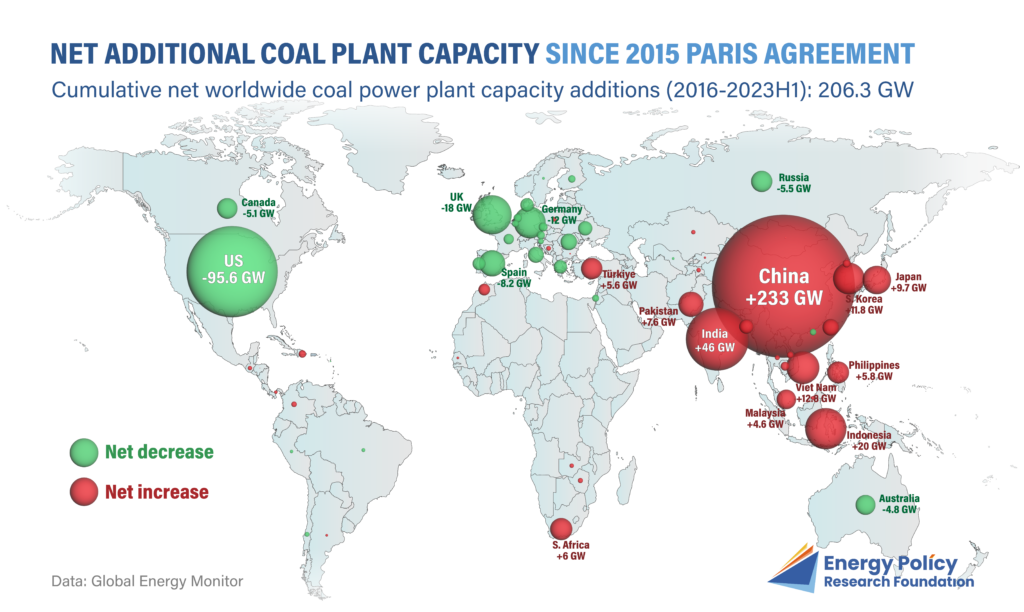
Since the 2015 Paris Agreement, coal-fired generation capacity has fallen by 164.4 GW in developed countries while rising by a net 360 GW across developing countries, with China alone accounting for nearly two-thirds of global additions.

Changes in global coal power plant capacity since the 2015 Paris Agreement reflect varying energy security challenges, economic conditions, and alternative fuel options around the world.
A significant divergence occurred between North America/Europe (excl. Turkiye) and Asia. According to the Global Energy Monitor’s Global Coal Plant Tracker, data from 2016 to H1 2023 shows a net decrease in coal generation capacity of 164.4 GW in the former group. In contrast, the net change in Asia was 360 GW (increase) during that period.
Thanks to the massive coal-to-gas switching on the back of the Shale Revolution, the United States has emerged as the global leader in reducing coal generation capacity, with cumulative net coal retirements of 95.6 GW during this period. The US operational coal plant capacity was 205 GW as of July 2023.
In Asia, China accounted for almost two-thirds of the total coal generation additions despite experiencing a decrease in incremental capacity compared to the period before the Paris Agreement. China’s current coal fleet capacity stands at 1,108 GW, but it has an additional 136 GW under construction and 255.5 GW of announced and permitted coal power plants.
From the EPRINC Chart of the Week archive.